Dubai is one of the fastest-growing business hubs in the world. Whether you’re a local entrepreneur or a foreign investor, obtaining a commercial license in Dubai is the essential first step to legally start your business.
What is a Commercial License?
A commercial license in Dubai is a legal permit that allows businesses to engage in trading activities such as buying, selling, importing, and exporting goods within the UAE. This license is mandatory for any business planning to trade products or provide commercial services in Dubai and is issued by the Department of Economy and Tourism (DET), formerly known as the Department of Economic Development
What Are the Types of Commercial Licenses in Dubai?
Dubai defines multiple commercial license types based on jurisdiction and activity.
Mainland vs. Free Zone:
| Type | Jurisdiction | Foreign Ownership | Common Use Cases |
| Mainland License | DED (Mainland) | Up to 100% (post-2021) | Local trading, retail, logistics |
| Free Zone License | Free Zone Authority | 100% | Export/import, e-commerce, services |
| Offshore License | Offshore | 100% | Holding companies, global operations |
Key Differences Between Mainland and Free Zone Setups
The choice between mainland and free zone setups significantly impacts the application process and operational flexibility. Here’s a detailed comparison:
| Aspect | Mainland Setup | Free Zone Setup |
| Authority | Department of Economy and Tourism (DET) | Respective Free Zone Authority (e.g., IFZA, Meydan) |
| Ownership | Requires local sponsor (unless UAE national) | 100% foreign ownership allowed |
| Market Access | Access to local UAE market | Restricted to free zone and international markets |
| Processing Time | Typically longer, standard process | Often faster, with instant options available |
| Additional Requirements | May need lease agreement, local sponsor agreement | Minimal, often just passport and activity selection |
| Cost Range | AED 15,000–28,500+, plus sponsor fees | Similar range, but may include setup packages |
This table highlights the trade-offs, with free zones offering simplicity and ownership benefits, while mainland provides broader market access but with more regulatory hurdles.
How To Get a Commercial License in Dubai?
Step 1: Choose Your Business Activity and Legal Structure
Define your specific business activities as this determines the type of license required. Select an appropriate legal structure such as:
- Sole Proprietorship
- Limited Liability Company (LLC)
- Branch of a foreign company
Step 2: Reserve Your Trade Name
Choose a unique company name that complies with DET naming regulations. The name must be distinctive, not similar to existing companies, and follow UAE naming conventions avoiding offensive language or well-known organization names. You can reserve your chosen name online through the DET website.
Step 3: Apply for Initial Approval
Submit your initial application electronically through the DET website, including details about your business activity, legal structure, and proposed trade name. Once approved, you’ll receive an Initial Approval Certificate.
Step 4: Secure Business Premises
Lease a commercial space in Dubai and register your tenancy contract with Ejari, the rental tenancy regulatory system. You’ll need an attested copy of this lease contract for your license application.
Step 5: Prepare Required Documents
Gather all necessary documentation for your application:
- Passport copies of all shareholders and partners
- Visa copies or UAE entry stamp (for foreign applicants)
- Emirates ID copy (if applicable)
- Trade name reservation certificate
- Initial approval certificate from DED or Free Zone authority
- Memorandum of Association (MoA) or Local Service Agent agreement (notarized for mainland companies)
- Tenancy contract (Ejari) for business premises
- No Objection Certificate (NOC) from current sponsor (if applicable)
- Completed application form for commercial license
- Two passport-sized color photographs of each shareholder (some authorities require this)
- External approvals (if your business activity requires permissions from specific authorities)
Step 6: Submit Application and Pay Fees
Submit your complete application with all required documents to the DET commercial registry. If everything is in order, the company name is added to the Commercial Register and documents are forwarded to the Federal Ministry of Economy. Pay the required fees, which typically range from AED 3,000 to AED 25,000 depending on the business activity and location.
Step 7: Receive Your Commercial License
After document approval and fee payment, you’ll receive your commercial license from the Department of Economy and Tourist. The process can be completed within 10 minutes for online applications or within 4 days for traditional applications.
Step 8: Register with Dubai Chamber of Commerce
After obtaining your trade license, register your company with the Dubai Chamber of Commerce and Industry. This registration is necessary for legal business operations and accessing trade certifications.
Commercial Trade License Dubai Cost
Obtaining a commercial trade license in Dubai requires several fees that vary by jurisdiction and services chosen. In the mainland, the Department of Economy and Tourism charges a core license fee of AED 3,000–AED 5,000, depending on the business activity and legal structure . Administrative costs for name reservation, initial approval, and processing add AED 500–AED 1,500 to the total .
Applicants must also secure and register office space, with Ejari registration fees of around AED 600 plus annual lease costs starting at AED 5,000 for shared offices . Sponsorship or service agent fees in mainland setups typically range from AED 10,000 to AED 25,000 per annum .
In free zones, trade license packages are priced between AED 7,000 and AED 12,000 and often include one to three visa allocations and flexi-desk facilities . Additional costs such as registration, shareholder documents, and office upgrades can add AED 1,000–AED 3,000 .
Annual renewals mirror initial fees but may be slightly reduced for long-term commitments . Expedited approvals incur surcharges of AED 500–AED 1,000, while late renewals attract fines starting at AED 500 per month . Proper budget planning and understanding jurisdictional differences ensure a smooth licensing process in Dubai’s dynamic market.
The Renewal Process of The Commercial License
Renewing your trade license may seem daunting, especially with the documentation and deadlines involved. However, with the right guidance and preparation, the process can be smooth and hassle-free.
Step 1: Ensure a Valid Tenancy Contract
For companies registered in the Dubai mainland, having a valid tenancy contract is a prerequisite for renewing your business license. Here’s what you need to know:
- Validity: Your tenancy contract must be valid for at least one month beyond the renewal date.
- Attestation: The contract should be attested by a notary public (jury attestation) to confirm its authenticity.
This tenancy contract acts as proof of your business’s physical presence and operational base in Dubai, which is a fundamental requirement for license renewal.
Step 2: Apply for License Renewal
Once your tenancy contract is in place, the next step is to apply for the license renewal. The process differs slightly depending on your company’s jurisdiction:
- Mainland Companies: Submit your renewal application to the Department of Economic Development (DED) along with all the necessary documents.
- Free Zone Companies: Apply for renewal through the relevant free zone authority governing your business location. Often, the tenancy contract renewal is coordinated simultaneously with the license renewal.
- Offshore Companies: Renewal can be completed through your registered agent who manages your offshore business affairs.
It is highly advisable to engage an authorized business agent during this step. Such professionals can meticulously review your documents before submission, reducing the risk of errors or delays.
Step 3: Pay the Renewal Fee and Receive Your License
After submitting your application, the Department of Economic Development or the respective free zone authority will issue a payment voucher. Completing the payment promptly is essential to finalize the renewal process.
Once the payment is confirmed, you will receive your renewed trade license, officially authorizing your business activities for another year.
Making the Renewal Process Easier
Despite the Department of Economic Development’s efforts to simplify license renewal, handling the paperwork and deadlines can still be challenging for entrepreneurs. This is where expert advisory services come into play.
Business setup consulting and company formation advisory services provide strategic business inputs and manage all legal documentation on your behalf. They ensure a seamless renewal process, allowing you to focus on growing your business rather than navigating bureaucratic hurdles.
What are the Other Kinds of Business Licenses in Dubai?
Dubai offers several types of business licenses tailored to different activities
- Commercial License: For businesses involved in trading goods and services, import/export activities, and wholesale trading
- Professional License: Designed for service-oriented businesses including consultancy, education, legal advisory, and other professional services
- Industrial License: For businesses engaged in manufacturing, production, or industrial activities
- Tourism License: Specific to companies in the tourism sector with unique regulations and requirements
Benefits of Having a Commercial License in Dubai
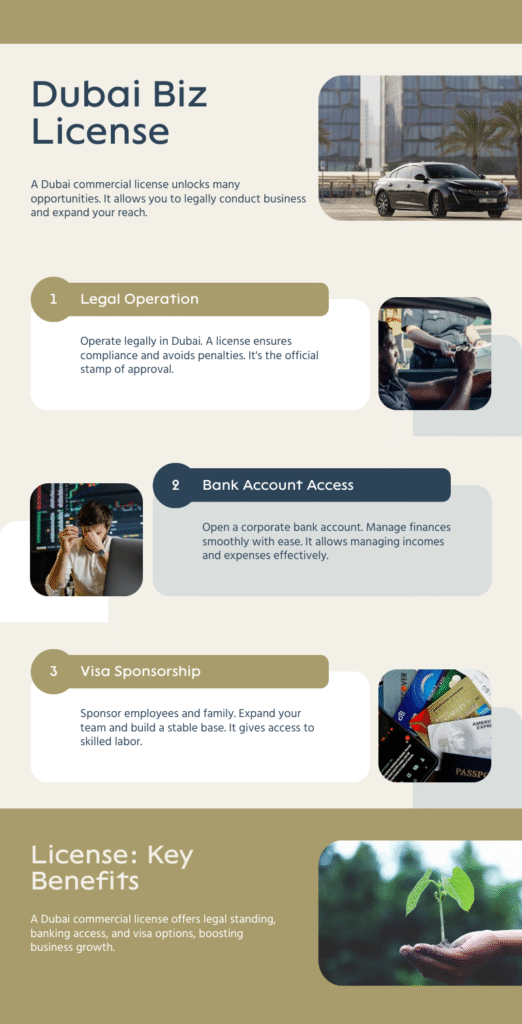
Acquiring a commercial license in Dubai opens the door to a world of legal, financial, and strategic advantages for business owners. Here’s a breakdown of its core benefits:
1. Legal Right to Trade
A commercial license authorizes your business to legally engage in buying, selling, and distributing goods and commodities across Dubai and the UAE. This includes both local trade and international import-export activities.
Entity: Business
Attribute: Legal Permission
Value: Trade in goods/services
2. Access to the UAE Market
With a valid commercial license, you gain unrestricted access to Dubai’s lucrative consumer and B2B markets. This positions your business in a thriving economy with strong government support for entrepreneurship.
3. Visa Eligibility for Owners and Employees
A commercial license allows you to sponsor visas for yourself, partners, family members, and employees—enabling a fully-operational team structure within Dubai.
4. Banking and Corporate Credibility
Licensed entities can:
- Open corporate bank accounts
- Access trade finance and credit facilities
- Build trust with clients and suppliers
Banks and investors prefer working with licensed companies for risk mitigation.
5. Ability to Operate Both Online and Offline
With a commercial license, you can open physical shops or warehouses and also launch e-commerce platforms. This omnichannel flexibility increases business visibility and revenue streams.
6. Eligibility for Government Contracts
Licensed companies can tender for public sector projects, access business incentives, and participate in UAE government programs—opportunities unavailable to unlicensed entities.
7. Ease of Expansion
Holding a commercial license simplifies the process of:
- Adding new business activities
- Branching out to other Emirates
- Forming partnerships and JVs
Dubai’s flexible regulatory environment supports business scaling and diversification.
8. Enhanced Business Reputation
Clients and partners perceive licensed businesses as trustworthy and compliant, which enhances brand authority and customer retention—crucial for long-term growth.
9. Tax Efficiency and Benefits
Although Dubai introduced VAT in 2018, there’s still no personal income tax, and corporate taxes remain minimal for many sectors—offering attractive financial leverage for startups and SMEs.
10. Customs and Logistics Advantages
With a commercial license, businesses gain:
- Preferential access to free zones
- Simplified customs clearance
- Participation in global logistics and trade corridors
Activities Covered by Commercial License Dubai
A commercial license in Dubai permits businesses to engage in trading activities involving tangible goods and certain service-related trade operations under the Department of Economy and Tourism (DET) or relevant free-zone authorities . Companies holding this license can conduct a defined scope of up to ten trading activities per license, ensuring regulatory compliance while enabling diverse commercial operations .
Core Trading Activities
Commercial license holders may perform the following primary trading operations:
- General Trading: Buying and selling a broad range of goods across multiple product categories under one license.
- Import/Export: Bringing goods into the UAE or sending products abroad, including customs clearance and logistics services.
- Wholesale Trading: Bulk distribution of products to retailers, businesses, or government entities.
- Retail Trading: Sale of goods directly to end consumers through physical stores or outlets.
- E-Trading: Selling goods online via websites, mobile apps, or social media platforms, including coordination with payment gateways.
Specialized Trade Activities
Businesses may also select from specialized trading activities to match niche market needs:
- Automotive Trading: Sales of motor vehicles, parts, and accessories.
- Electronics & IT Trading: Distribution of electronic devices, software, and IT hardware.
- Foodstuff & FMCG Trading: Trading of food products, beverages, and fast-moving consumer goods.
- Textiles & Apparel Trading: Import, export, wholesale, or retail of fabrics, garments, and fashion accessories.
- Construction Materials Trading: Trade of building materials, tools, and equipment.
Support and Ancillary Trading Services
Under a commercial license, companies can also provide services supporting core trading functions:
- Logistics & Freight Services: Handling transportation, warehousing, and distribution.
- Packaging & Labeling Services: Supplying packaging materials and labeling goods for market readiness.
- Brokerage & Distribution: Facilitating trade between buyers and sellers, including commission-based trade brokering.
- Facility Management Rentals: Leasing equipment, electronic devices, or office spaces related to trading operations.
- Cleaning & Maintenance Supplies: Trade of products used in cleaning, sanitation, and maintenance services
What Is The Difference Between Trade License And Commercial License
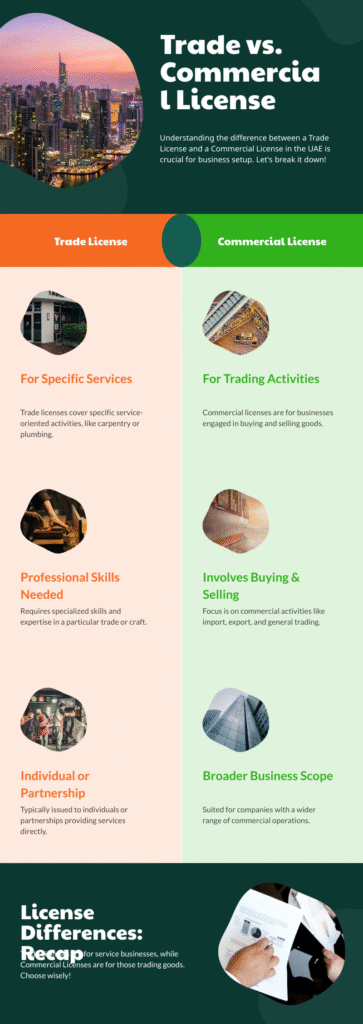
The difference between a trade license and a commercial license in Dubai (and the UAE generally) lies in their scope and the specific business activities they permit:
Trade License:
- This is a general term for the official permit required for any business to operate legally within the UAE, regardless of the industry or sector.
- It covers all types of business activities, including commercial, professional, industrial, and others.
- The trade license is mandatory for all businesses and ensures compliance with local laws and regulations.
- It legitimizes the business and is required before starting operations.
Commercial License:
- This is a specific type of trade license, designed for businesses involved in trading activities—buying and selling goods or certain trade-related services.
- It is required for companies engaged in retail, wholesale, import/export, real estate, and similar sectors.
- The commercial license allows businesses to conduct up to ten trading activities under a single license.
- It is a subtype of the trade license, meaning every business with a commercial license holds a trade license, but not every trade license is a commercial license.
What’s the Difference Between a Professional License and a Commercial License in Dubai?
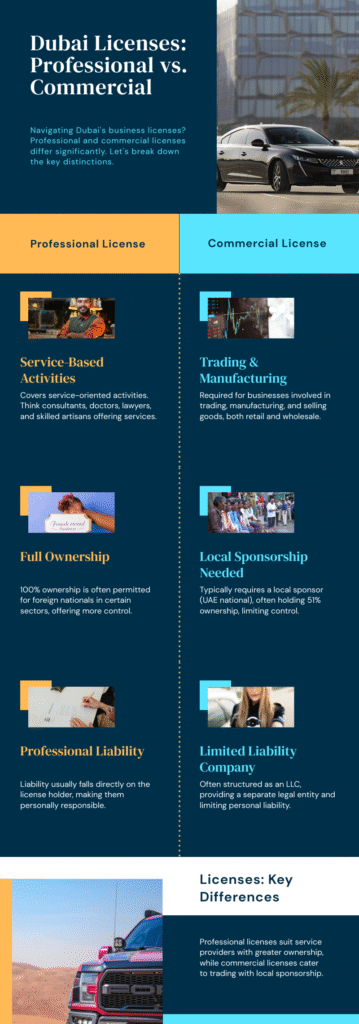
The main differences between a professional license and a commercial license in Dubai relate to the types of business activities allowed, ownership rules, legal liability, and company structure. Here’s a detailed comparison:
| Feature | Commercial License | Professional License |
| Business Activity | Allows trading of goods (import/export, retail, etc.) and some related services. | Allows provision of professional services (consulting, medical services, education, crafts, etc.). |
| Ownership | On the Mainland, previously required a local partner (51% UAE national; 49% foreign), but now 100% foreign ownership is possible in many cases. In Free Zones, 100% foreign ownership is standard. | 100% foreign ownership is allowed even on the Mainland. |
| Legal Structure | Typically issued as a Limited Liability Company (LLC). | Typically issued as a Sole Establishment or Civil Company (with a Local Service Agent, who has no liability or ownership). |
| Liability | Limited liability for shareholders in an LLC. | Unlimited liability for the owner unless structured as an LLC (which is rare for professional licenses). |
| Minimum Share Capital | Historically AED 300,000, but now often reduced to AED 100,000 (no proof of payment required in practice). | AED 150,000 (no proof of payment required in practice). |
| License Fee | Higher (approx. AED 17,000). | Lower (approx. AED 11,000). |
How The Infinite Service Can Help You with Commercial License in Dubai
At The Infinite Service, we specialize in offering comprehensive business advisory solutions tailored to the Dubai market. Our team of experts handles every aspect of your license renewal, from scrutinizing documents to submitting applications and coordinating payments, ensuring a hassle-free experience.
If you are looking to renew your business license in Dubai, don’t hesitate to reach out to us. We provide strategic advice and legal support to keep your business compliant and thriving.
Contact The Infinite Service today to speak with our consultants and simplify your business license renewal process: